Why S3 is Still the Safest Place for Static Websites (and When It's Not)
Why S3 is Still the Safest Place for Static Websites (and When It’s Not)
 When developers debate the best hosting solution for static websites, Amazon S3 consistently emerges as the champion. But in 2026, with countless hosting alternatives flooding the market, is S3 still the safest choice for your static site?
Why S3 is Still the Safest Place for Static Websites (and When It’s Not)
When developers debate the best hosting solution for static websites, Amazon S3 consistently emerges as the champion. But in 2026, with countless hosting alternatives flooding the market, is S3 still the safest choice for your static site?
The short answer: absolutely. But like any technology decision, it comes with nuances worth understanding.
After hosting dozens of static sites on various platforms over the past few years, I’ve learned that S3’s reputation for safety isn’t just marketing it’s built on solid technical foundations that most alternatives struggle to match.
What Makes S3 the “Safest” Choice for Static Websites
Unmatched Infrastructure Reliability
Amazon S3 boasts an impressive 99.999999999% (11 9’s) durability and 99.99% availability SLA. This isn’t just a number on a spec sheet it represents decades of infrastructure investment and battle-tested systems.
When you upload your static website to S3, your files are automatically replicated across multiple facilities within your chosen AWS region. This means even if an entire data center goes offline, your website remains accessible.
Compare this to traditional shared hosting where a single server failure can take your site down for hours or days.
Built-in DDoS Protection and Security
S3 integrates seamlessly with AWS Shield Standard, providing automatic DDoS protection at no additional cost. For static websites, this means your site can handle traffic spikes without breaking a sweat or your budget.
The security model is equally robust:
- IAM integration for granular access control
- Bucket policies for fine-tuned permissions
- Server-side encryption options (SSE-S3, SSE-KMS, SSE-C)
- Access logging for security auditing
- MFA delete protection for critical buckets
Predictable and Transparent Pricing
Unlike many hosting providers with hidden fees and surprise charges, S3’s pricing is straightforward:
- Storage: $0.023 per GB for the first 50 TB
- Requests: $0.0004 per 1,000 GET requests
- Data transfer: First 1 GB free, then $0.09 per GB
For most static websites, this translates to under $5 per month for sites with moderate traffic. No surprise bandwidth charges, no sudden price hikes when you hit arbitrary limits.
Global Content Delivery with CloudFront Integration
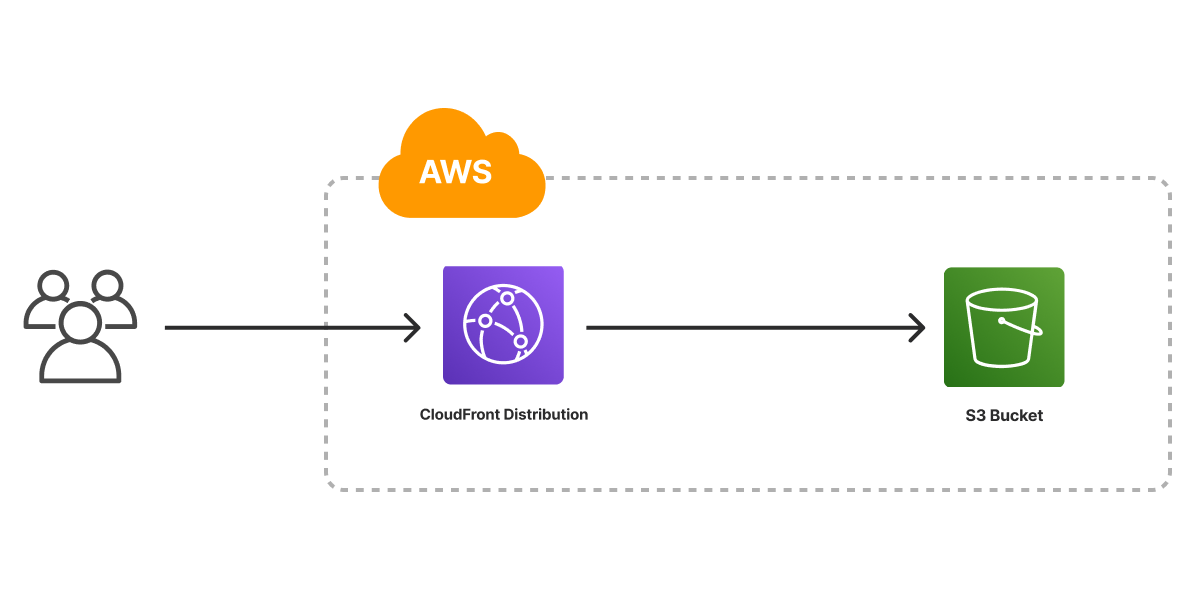
While S3 alone provides excellent reliability, pairing it with Amazon CloudFront creates an unbeatable combination for static website hosting:
- Global edge locations reduce latency worldwide
- Automatic HTTPS with free SSL certificates
- Custom domain support with Route 53 integration
- Compression and optimization built-in
- Real-time metrics and monitoring
The Technical Advantages That Matter
Version Control and Rollback Capabilities
S3’s versioning feature acts as a safety net for your static website deployments. Made a mistake in your latest update? Rolling back is as simple as changing which version is served.
This is particularly valuable when combined with automated deployment pipelines. You can deploy with confidence knowing that reverting to a previous version takes seconds, not hours of frantic debugging.
Seamless CI/CD Integration
S3 integrates effortlessly with modern deployment workflows:
# Simple deployment with AWS CLI
aws s3 sync ./build s3://your-website-bucket --delete

# With CloudFront cache invalidation
aws cloudfront create-invalidation --distribution-id YOUR_ID --paths "/*"
This simplicity means your deployment pipeline remains maintainable and reliable, reducing the chance of human error during updates.
Monitoring and Alerting
AWS CloudWatch provides comprehensive monitoring for your S3-hosted website:
- Request metrics to track traffic patterns
- Error rate monitoring to catch issues early
- Cost tracking to avoid billing surprises
- Custom alarms for proactive notifications
When S3 Might Not Be Your Best Choice
Dynamic Content Requirements
S3 is designed for static content. If your website needs:
- Server-side processing (PHP, Python, Node.js)
- Database connections
- Real-time features (WebSockets, live chat)
- User authentication beyond basic auth
You’ll need to look elsewhere. Consider AWS Amplify, Vercel, or Netlify for static sites with dynamic features, or EC2/ECS for fully dynamic applications.
Complex Routing and Redirects
While S3 supports basic redirects and error pages, complex routing scenarios can be challenging:
- Single Page Applications (SPAs) with client-side routing
- Complex URL rewriting rules
- A/B testing with traffic splitting
- Geolocation-based content serving
For these use cases, platforms like Netlify or Vercel offer more sophisticated routing capabilities out of the box.
Team Collaboration and Preview Deployments
S3 lacks built-in features for:
- Branch-based preview deployments
- Pull request previews
- Team collaboration workflows
- Built-in form handling
If your team relies heavily on these features, specialized static hosting platforms might offer better developer experience.
Budget Constraints for High-Traffic Sites
While S3 is cost-effective for most sites, high-traffic websites might find alternatives more economical:
- GitHub Pages: Free for public repositories
- Netlify: Generous free tier with 100GB bandwidth
- Vercel: Free tier suitable for personal projects
- Cloudflare Pages: Unlimited bandwidth on free tier
Best Practices for S3 Static Website Hosting
Security Configuration
{
  "Version": "2012-10-17",
  "Statement": [
    {
      "Sid": "PublicReadGetObject",
      "Effect": "Allow",
      "Principal": "*",
      "Action": "s3:GetObject",
      "Resource": "arn:aws:s3:::your-website-bucket/*"
    }
  ]
}
Always use the principle of least privilege and consider using CloudFront with Origin Access Identity (OAI) instead of public bucket access.
Performance Optimization
- Enable gzip compression in CloudFront
- Set appropriate cache headers for static assets
- Use CloudFront’s compression for text-based files
- Optimize images before uploading to S3
Cost Management
- Use S3 Intelligent Tiering for infrequently accessed content
- Set up lifecycle policies to automatically transition old versions
- Monitor CloudWatch metrics to understand usage patterns
- Use S3 Transfer Acceleration only when necessary
The Verdict: S3’s Continued Dominance
In 2026, Amazon S3 remains the safest choice for static website hosting because it excels in the fundamentals that matter most:
Reliability: Proven track record with industry-leading uptime Security: Enterprise-grade protection with granular controls
Scalability: Handles traffic from zero to millions without configuration Integration: Seamless connection with the broader AWS ecosystem Transparency: Clear pricing and no vendor lock-in concerns
While newer platforms offer compelling features for specific use cases, S3’s combination of safety, reliability, and cost-effectiveness makes it the gold standard for static website hosting.
Making the Right Choice for Your Project
Choose S3 + CloudFront when you need:
- Maximum reliability and uptime
- Predictable costs at any scale
- Enterprise-grade security features
- Integration with existing AWS infrastructure
- Long-term stability and vendor reliability
Consider alternatives when you need:
- Built-in CI/CD and preview deployments
- Complex routing and redirect capabilities
- Integrated form handling and serverless functions
- Team collaboration features
- Zero-cost hosting for personal projects
The beauty of S3 is that it remains a safe fallback option. Even if you start with another platform, migrating to S3 is straightforward, making it an excellent insurance policy for your static website hosting strategy.
Ready to host your static website on S3? Start with the AWS Free Tier and experience the reliability that has made S3 the backbone of the modern web.